
If you switch on e-invoicing for your event, your participant can have the invoice delivered to their organisation as an e-invoice through the PEPPOL network. Paying the invoice is separate from that.
Table of contents
- Switching on e-invoicing
- How does a participant choose e-invoicing?
- Company name, order number and KvK or OIN number
- Feedback on incorrect input
- Paying the invoice
Switching on e-invoicing
You can only switch on e-invoicing if you use the payment method Bank transfer, with automatic processing. An e-invoice is usually paid afterwards by bank transfer.
Step 1:
Go to Dashboard > Event website > Ticket configuration.
Step 2:
In the block Payment settings, make sure that Bank transfer is on at Allow payments via, and that Automatic bank transfer processing is ticked.
Step 3:
Tick E-invoicing.
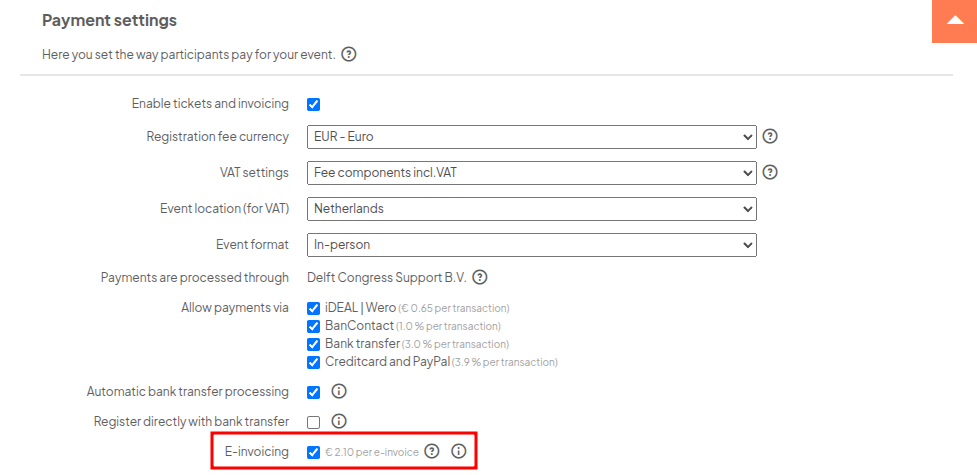
Warning: E-invoicing does not work with bank transfer to your own bank (bank transfer without automatic processing). As long as Bank transfer is not on or not processed automatically, you cannot tick E-invoicing. If you later switch off bank transfer or its automatic processing, e-invoicing is switched off as well.
How does a participant choose e-invoicing?
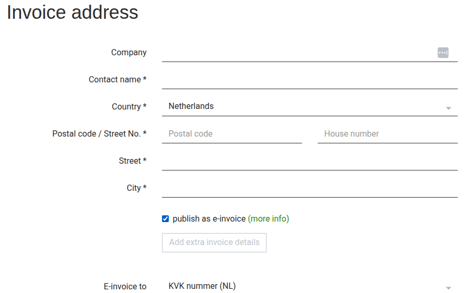
On the payment page, the participant fills in the details that should appear on the invoice. Below these invoice details is the tick box publish as e-invoice (more info). The link 'more info' explains what e-invoicing is. It is there because some participants think an e-invoice is the same as a PDF invoice.
When the participant ticks publish as e-invoice, they get an explanation of which details are needed to create and send the e-invoice. Only governments and companies connected to the PEPPOL network can choose e-invoicing.
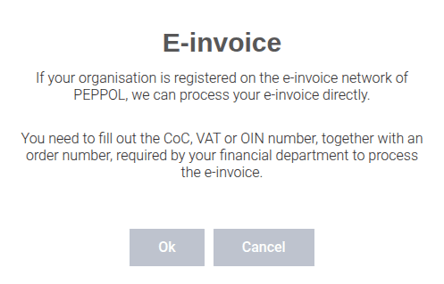
Note: This explanation also mentions the VAT number. That only applies to organisations in Belgium or Luxembourg. A Dutch VAT number cannot be used for an e-invoice.
Company name, order number and KvK or OIN number
Three details are required for an e-invoice:
- Company name: the name of the organisation that receives the invoice.
- Order number: tells the finance department which cost centre the invoice belongs to, so they can pay it.
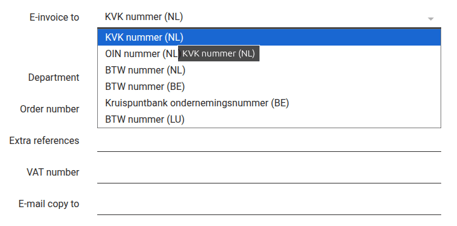
- Identification number: at E-invoice to, the participant chooses the type of number and fills in the number.
At E-invoice to these numbers are possible:
- KVK nummer (NL): the Dutch Chamber of Commerce (KvK) number
- OIN nummer (NL): the number Dutch government organisations use to identify themselves
- BTW nummer (BE): the Belgian VAT number
- Kruispuntbank ondernemingsnummer (BE): the Belgian enterprise number
- BTW nummer (LU): the Luxembourg VAT number
A Dutch organisation can only identify itself with its KvK or OIN number. A Dutch VAT number can no longer be used since October 2026.
Once the details are filled in, we create an e-invoice in the background and send it through the PEPPOL network. The participant also receives the PDF invoice by email, as a copy and for their own records.
Feedback on incorrect input
If the number is not known on PEPPOL, the participant sees a message such as: "The KVK nummer (NL) that you filled in is unknown on PEPPOL. This means that this organisation is not ready for e-invoicing. Continue without e-invoicing or choose another number".

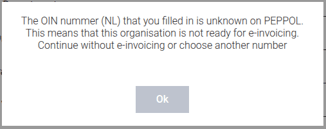
If a required detail is missing, the participant cannot continue. They then see one of these messages:
- "Fill in a company name (mandatory for e-invoicing)."
- "Fill in an order number (mandatory for e-invoicing)."
- "Fill in a CoC, VAT or OIN number (mandatory for e-invoicing)"
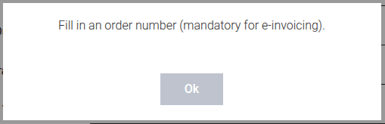
Paying the invoice
When a participant chooses e-invoicing, they usually want their employer to pay the invoice after receiving the e-invoice. The participant then chooses Bank transfer. That is why bank transfer with automatic processing is always on when you use e-invoicing.
Participants can also combine the e-invoice with a direct payment, such as iDEAL, Bancontact or credit card. E-invoicing is separate from the way of paying: it only sends the invoice through the PEPPOL network, for example to the employer. The chosen payment method decides how the invoice is paid.
Caution: Sending an e-invoice through PEPPOL comes with costs. You see what an e-invoice costs behind the E-invoicing tick box in the Ticket configuration and on our pricing page.
Note: Questions about prices and rates? Our Support team is happy to help you with information about our rates! Feel free to contact us:
Phone number: +31 15 240 01 19
Email: info@aanmelder.nl
Contact form: Fill in the contact form